
Rental Income Tax in Pakistan 2026-27: A Landlord’s Guide (Tax Year 2027)
If you let out a house, flat, shop or hostel in Pakistan, the rent is taxable income, and the rules for tax year 2027 (1 July 2026 to 30 June 2027) are now settled in the Finance Act 2026. The good news for landlords is that clean records do most of the work: they decide how much you can deduct, how much tax already withheld by your tenant counts in your favour, and how easily you can answer any question about your property.
This guide explains how rental income is taxed for individual landlords, the withholding tax tenants deduct from rent, the deductions the law allows, how filer status changes the numbers, the provincial taxes to keep an eye on, and the records that protect you.
Not tax advice. This article is general information based on FBR and provincial sources read on 13 November 2026. Tax law changes, and your situation may differ. Please consult a qualified tax adviser before filing a return or deciding how to treat your rental income.
Quick answer: how is rental income taxed in Pakistan?
- Rent is taxed under the head “Income from Property” (Income Tax Ordinance 2001, section 15).
- For individuals, there is no separate rent-only rate table any more. The special rate for individuals’ property income was removed by the Finance Act 2021 (see the footnote to section 15 in FBR’s consolidated Ordinance), so rent is added to your other income and taxed at the normal individual slabs.
- Certain tenants, such as companies and government bodies, must deduct withholding tax from the rent under section 155. For individual landlords in tax year 2027 this is nil up to PKR 300,000 of gross annual rent, rising in slabs to 25% above PKR 2 million (FBR Withholding Tax Rate Card, TY2027).
- That withheld tax is not a final tax. You declare the rent in your return and the deducted amount counts towards your bill.
- If you are not on the Active Taxpayers’ List (ATL), withholding rates are generally doubled (Tenth Schedule, rule 1).
Which tax year applies?
Pakistan’s normal tax year runs for twelve months ending on 30 June and is named after the year it ends in (section 74). So rent received or receivable under section 15 from 1 July 2026 to 30 June 2027 falls in tax year 2027. For an individual, the return for that year is due on or before 30 September 2027, unless FBR extends the deadline (section 118(3)), filed through FBR’s IRIS portal.
You must file a return if your taxable income for the year is above the amount that is not chargeable to tax (section 114(1)(ab)). For a non-salaried individual, the 0% band in the current rate table covers taxable income up to PKR 600,000 (see the rate table below).
What counts as rent
Section 15 of the Income Tax Ordinance defines rent as any amount received or receivable by the owner of land or a building for its use or occupation. A few details matter for landlords:
- Utilities, amenities and services. Where part of the rent is for amenities, utilities or other services connected with renting the building, that part is taxed under “Income from Other Sources”, not property income (section 15(3A)). Hostels and furnished lets that bundle meals, electricity or cleaning should keep these amounts visible in their records.
- Building let with plant and machinery. Rent for a building leased together with plant and machinery is also taxed as “Income from Other Sources” (section 15(3)).
- Below-market rent. If you charge less than the fair market rent, you can be treated as having received the fair market rent (section 15(4)), with an exception where the tenant is taxed on it as salary (section 15(5)).
- Non-adjustable amounts. If a tenant pays you an amount that is not adjustable against rent, it is treated as rent and spread equally over the year of receipt and the next nine tax years (section 16). Section 16 also has rules for when such an amount is refunded early. Ask your adviser how this applies to any advance or deposit you take.
Write each of these amounts separately in your rent agreement and receipts. Our rent agreement format for Pakistan already keeps advance rent, security and pagri on separate lines for this reason.
Deductions landlords can claim (section 15A)
You are taxed on rent minus allowable deductions. Section 15A lists them:
| Deduction | What the law allows |
|---|---|
| Repairs allowance | One-fifth (20%) of the rent chargeable, worked out before other deductions |
| Insurance | Premium paid to insure the building against damage or destruction |
| Local taxes | Any local rate, tax, charge or cess paid to a local authority or government on the property or its rent (not income tax) |
| Ground rent | Ground rent paid for the property |
| Borrowing costs | Profit or interest paid on money borrowed to acquire, build, renovate, extend or rebuild the property, including mortgage profit |
| Bank or HBFC rent-sharing schemes | The bank’s or HBFC’s share of rent and appreciation (not return of capital) |
| Administration and collection | Up to 4% of the rent chargeable, spent wholly for earning the rent |
| Legal costs | Legal fees to defend your title to the property or a suit connected with it |
| Irrecoverable rent | Unpaid rent, if the tenancy was genuine, the tenant has left or steps were taken to evict, the tenant does not occupy any other property of the landlord, you have taken reasonable legal steps, and the rent was already taxed in the year it was due |
Two things stand out for landlords who keep good records:
- The repairs allowance is automatic. It is one-fifth of the rent, not your actual repair bills, so it does not depend on receipts. The other deductions do.
- Unpaid rent is only deductible with a paper trail. To claim it you need to show the tenancy, the default and your recovery steps. A rent ledger with dated charges, payments and follow-ups is exactly that evidence. If a deducted amount is later recovered, it becomes taxable in the year you recover it (section 15A(2)).
Keep every challan and receipt for property tax, insurance and loan profit with the property it belongs to. Our post on tracking every expense and vendor bill covers a simple routine.
Income tax rates for individual landlords, tax year 2027
Because rent is now added to your other income, the rate that applies is the normal individual rate. For individuals and associations of persons other than salaried individuals, the table in Division I, Part I of the First Schedule is (FBR consolidated Ordinance, printed page 506):
| Taxable income (PKR a year) | Tax |
|---|---|
| Up to 600,000 | 0% |
| 600,001 to 1,200,000 | 15% of the amount above 600,000 |
| 1,200,001 to 1,600,000 | 90,000 + 20% of the amount above 1,200,000 |
| 1,600,001 to 3,200,000 | 170,000 + 30% of the amount above 1,600,000 |
| 3,200,001 to 5,600,000 | 650,000 + 40% of the amount above 3,200,000 |
| Above 5,600,000 | 1,610,000 + 45% of the amount above 5,600,000 |
Two notes:
- Salaried landlords. If salary is more than 75% of your taxable income, a different, lower table for salaried individuals applies (Division I, clause (2) of the same Schedule). If you have a job and one let property, check which table you fall under with your adviser.
- Surcharge. Individuals and associations of persons pay a 10% surcharge on income tax where taxable income exceeds PKR 10 million, under section 4AB. If you earn both salary and rent, ask an adviser how the salary proviso applies to you (section 4AB).
Withholding tax on rent: section 155
Under section 155, a “prescribed person” paying rent must deduct tax from the gross rent, including advance payments and amounts for furniture, fixtures and services connected with the property.
Who has to deduct? The prescribed persons are the Federal Government, a Provincial Government, a Local Government, a company, a non-profit organisation or charitable institution, a diplomatic mission, a private educational institution, boutique, beauty parlour, hospital, clinic or maternity home, individuals or associations of persons paying gross rent of PKR 1.5 million or more in a year, and anyone else the FBR notifies (section 155(3)).
In practice, a family renting a house from you for less than PKR 1.5 million a year is not on that list, so no tax is withheld and your whole liability is settled through your return.
Rates for tax year 2027 (FBR Withholding Tax Rate Card TY2027, matching Division V, Part III of the First Schedule in the consolidated Ordinance):
| Gross annual rent (individual or AOP landlord) | Tax to be deducted |
|---|---|
| Up to PKR 300,000 | Nil |
| 300,001 to 600,000 | 5% of the amount above 300,000 |
| 600,001 to 2,000,000 | PKR 15,000 + 10% of the amount above 600,000 |
| Above 2,000,000 | PKR 155,000 + 25% of the amount above 2,000,000 |
| Company landlord | 15% of gross rent (30% if not on the ATL) |
Is it final? No. The sub-section that once made section 155 tax a final tax was omitted by the Finance Act 2010 (footnote to section 155 in the consolidated Ordinance). You declare the rent and the tax deducted, and the deduction counts against the tax worked out on your return.
Get your certificate. The tenant who deducts tax must give you a certificate of the amount deducted along with the Computerized Payment Receipt (CPR) or equivalent (section 164). Ask for it every time, and keep it with that month’s rent receipt. Without it, proving the credit is harder.
A worked example (illustration only)
Say you are an individual landlord, your only income is one shop let to a company at PKR 150,000 a month, you are on the ATL, and you have no other deductions:
| Step | Amount (PKR) |
|---|---|
| Gross rent for tax year 2027 (150,000 x 12) | 1,800,000 |
| Less repairs allowance (one-fifth) | 360,000 |
| Taxable income | 1,440,000 |
| Income tax: 90,000 + 20% of (1,440,000 minus 1,200,000) | 138,000 |
| Tax withheld by the company under section 155: 15,000 + 10% of (1,800,000 minus 600,000) | 135,000 |
| Balance payable with the return | 3,000 |
If the same landlord were not on the ATL, the withholding would be doubled under the Tenth Schedule to PKR 270,000, so far more cash would be held back during the year. Real cases with salary, several properties or other deductions will differ, which is why an adviser should check your own numbers.
Filer status: why being on the ATL protects you
The Tenth Schedule says that where tax is deducted or collected from a person who is not on the Active Taxpayers’ List, the rate is increased by 100%. For a landlord whose tenant is a company or an organisation, that means the applicable withholding amount is doubled. Filing your return on time keeps you on the list and keeps more of your rent in your hands during the year.
Note that the FBR rate card shows the 30% non-ATL rate for company landlords but leaves the non-ATL column blank for individuals; the doubling for individuals comes from the Tenth Schedule rule. Confirm the exact rate for your case with your adviser.
Section 7E deemed income has been removed
From 2022, section 7E treated part of the value of certain properties as deemed income, with an exclusion for property whose rent was already taxed. The Finance Act 2026 omitted section 7E (FBR consolidated Ordinance, section 7E), as also reported in Zameen’s Budget 2026-27 explainer. For let property, the main federal questions in tax year 2027 are therefore the ones above: declaring rent, claiming deductions and using withholding credits.
Provincial taxes on rented property
Income tax is federal. Provinces levy their own taxes on property and on some rent, collected by different departments. These are the ones we were able to check.
Punjab property tax (Urban Immovable Property Tax)
- Who pays: the tax is due from the owner (Punjab Urban Immovable Property Tax Act 1958, section 3(4)), and it is administered by the Punjab Excise, Taxation and Narcotics Control Department.
- How it is worked out: the Punjab Finance Act 2024 moved the tax to a taxable value taken from the official valuation table, with a Schedule of 0.07% to 0.09% and residential property up to PKR 5 million exempt (Punjab Finance Act 2024). Dawn reported the change as effective from 1 January 2025 (Dawn). The Excise department’s own Property Tax page still describes the older 5% of annual rental value method, so check your current PT-10 assessment with Punjab Excise. Transitional rules can affect the amount due.
- Payment and late charges: The Punjab Finance Act 2026 introduced electronic payment and moved late surcharges to a quarterly schedule. Check the due date and amount on your current assessment with Punjab Excise.
- Why it matters to landlords: if an owner does not pay, the department can issue a PT-14 notice telling the tenant to deposit the rent in the Government Treasury until the tax is cleared (Excise Property Tax page). Paying on time keeps your rent flowing to you. The property tax you pay is also a deductible local tax under section 15A(1)(c).
Punjab sales tax on commercial rent
Ask the Punjab Revenue Authority or a Pakistani tax adviser whether sales tax applies to your commercial lease and what registration or invoicing obligations apply.
Sindh, Khyber Pakhtunkhwa, Islamabad and Balochistan
Property tax and any sales tax on rent are set separately in each province and in Islamabad. We have not stated rates for them here. Check with the provincial Excise and Taxation department, the local revenue authority or your adviser.
Hostels and PGs: records that keep you on solid ground
Hostel owners face more paperwork than most landlords, and the same records serve every purpose:
- Guest reporting. In Punjab, the owner or manager of a hostel must report each guest to the police within twenty-four hours (Punjab Information of Temporary Residents Act 2015, section 3). Where HotelEye registration is enforced, hostel operators must keep it current (Esset HotelEye page).
- Separate the charges. Rent for the bed or room, meals, utilities and laundry should appear as separate lines, because amounts for amenities, utilities and services can fall under a different head of income (section 15(3A)). Whether a hostel’s income counts as property income or business income depends on how it is run; ask your adviser.
- One record per resident. A resident register, signed terms and a receipt for every payment are what let you answer any official query quickly and calmly.
A resident register, receipts and challans help your adviser review your records. Our guide to hostel and PG management software covers what to track day to day.
The landlord’s tax records checklist
Keep these for every property, every tax year:
- Signed rent agreement with rent, advance, security and any pagri on separate lines (rent agreement format).
- Tenant registration acknowledgement from the police, where your province requires it.
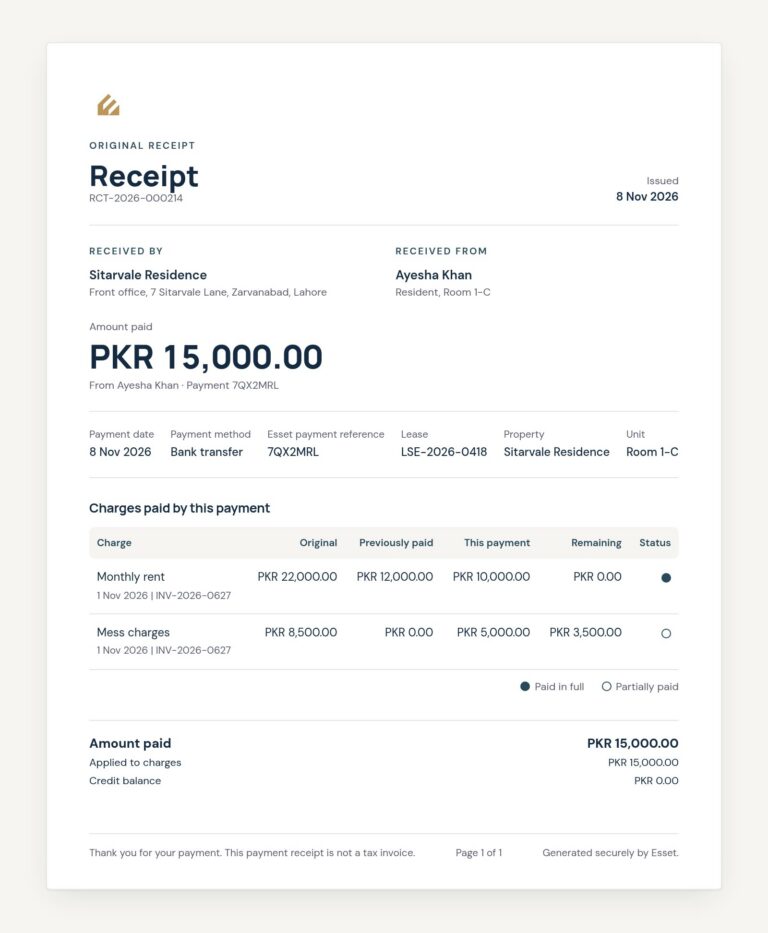
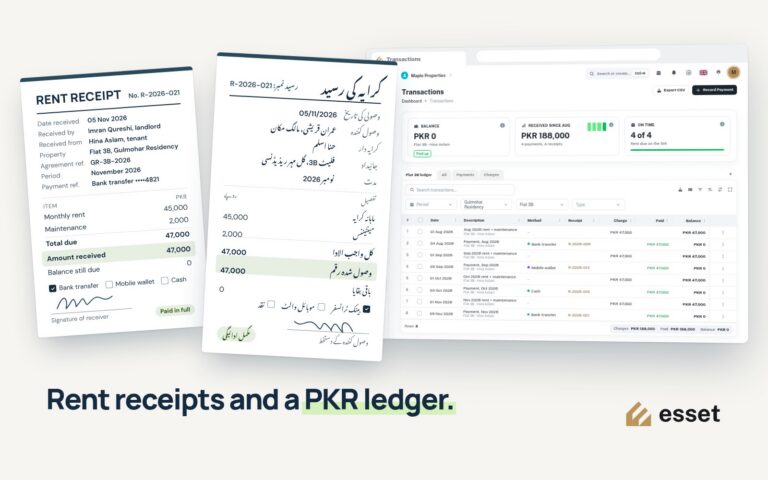
- A receipt for every rent payment, dated, with the method and reference (how to keep clear rent payment records).
- Bank or wallet statements showing the rent coming in.
- Section 155 certificates and CPRs from any tenant who deducts tax.
- Property tax challans (PT-10 in Punjab) and receipts for insurance, ground rent and loan profit.
- Legal and collection costs, with invoices.
- Arrears history: dated charges, reminders and recovery steps for any rent you may later claim as irrecoverable.
- Deposit records: what you hold, for whom, and what you returned.
If you live abroad, the same list applies; rental income from property in Pakistan is Pakistan-source income (section 101(9)). See managing rental property in Pakistan from abroad for running these records from overseas.
How property software helps at tax time
Esset is property management and accounting software built for Pakistani landlords, property managers and real estate businesses (esset.io/pk). It does not file returns or calculate your tax, and it is not connected to FBR or any provincial tax authority. What it does is keep the records your adviser needs in one place:
- Income and expenses by property. Esset’s property accounting software tracks rent, advances, late fees and other income, records and categorises expenses, keeps tenant ledgers, and produces income and expense reports you can share with your accountant.
- A full ledger. The Transactions list shows every payment, charge, expense, bill, deposit and transfer, so you can reconcile against your bank and give your accountant a complete record.
- Expenses tied to property. Every expense is recorded against a property and can be linked to a unit and payee (how to add and manage expenses).
- Deposits. The Security Deposit Liability report shows what you hold for each tenant.
- Co-owned property. Ownership percentages can be recorded per property on the Growth plan and above (owners and ownership), which helps when co-owners each declare their share. For reporting to owners, see owner reporting for Pakistani rental portfolios.
- Local payment methods. Rent can be collected via JazzCash, Easypaisa, bank transfer or cash and tracked in one place (property management software for Pakistan).
- Tenant app. Tenants can view their balance, invoices and receipts and submit payment proofs. You review each proof and approve it before it is recorded as a payment, so your books only show money you have confirmed.
For hostels, see Esset’s hostel management software. To compare options, read our guide to property management software in Pakistan, or start at esset.io/pk.
FAQ
Is rental income taxable in Pakistan?
Yes. Rent received or receivable for the use of land or a building is taxed under “Income from Property” (section 15). For individuals it is added to other income and taxed at the normal slabs.
How much tax is deducted from rent in 2026-27?
If your tenant is a prescribed person, the deduction for an individual landlord on the ATL is nil up to PKR 300,000 a year, 5% of the amount above that up to PKR 600,000, PKR 15,000 plus 10% up to PKR 2 million, and PKR 155,000 plus 25% above PKR 2 million (FBR rate card TY2027). Companies have 15% deducted.
Is the tax deducted under section 155 my final tax?
No. You still declare the rent in your return. The deducted amount counts towards the tax due, and you pay any balance or claim the difference as your adviser advises.
My tenant is a family. Do they deduct tax?
Usually not. Individuals and associations of persons are prescribed persons only if they pay gross rent of PKR 1.5 million or more in a year (section 155(3)). You still declare the rent yourself.
What if I am a non-filer?
Withholding rates for persons not on the Active Taxpayers’ List are increased by 100% under the Tenth Schedule, and company landlords not on the list face 30% instead of 15% (FBR rate card). Filing on time is the simplest protection.
Can I deduct repairs from rental income?
Yes, as a fixed allowance of one-fifth of the rent, whatever you actually spent (section 15A(1)(a)). Property tax, insurance, ground rent, loan profit, up to 4% for administration and collection, legal costs and qualifying unpaid rent are deductible on top.
Do overseas Pakistanis pay tax on rent from property in Pakistan?
Rental income from property in Pakistan is Pakistan-source income (section 101(9)). How it is taxed for a non-resident, and whether it is also taxed where you live, depends on your residency and any tax treaty, so ask an adviser.
Is there sales tax on rent in Punjab?
Ask the Punjab Revenue Authority or a Pakistani tax adviser whether sales tax applies to your commercial lease and what registration or invoicing obligations apply.
When is the return for tax year 2027 due?
For individuals, on or before 30 September 2027 (section 118(3)), unless FBR extends the date.
This article is general information, not tax, legal or financial advice. Figures are taken from FBR’s Income Tax Ordinance 2001 (amended up to 30 June 2026), FBR’s Withholding Tax Rate Card for tax year 2027 and the provincial sources linked above, read on 13 November 2026. Rates and rules can change. Please consult a qualified tax adviser about your own situation. Esset is a private software company and is not affiliated with FBR, the Punjab Revenue Authority, the Excise and Taxation departments or any government body.

Comments (0)